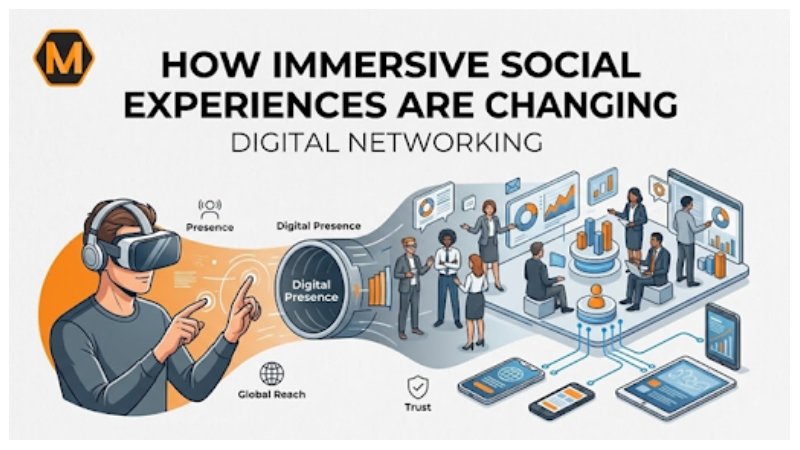
The way we connect with others is undergoing a massive transformation. For years, digital networking meant scrolling through static profile pages or sitting in front of a webcam for a 2D video call. While these tools kept us connected during the rise of remote work, they often felt draining and impersonal. However, we are now entering the era of “Spatial Presence,” where digital interactions feel as real as standing in the same room as someone else. Immersive social experiences—driven by virtual reality, augmented reality, and 3D spatial audio—are making the internet feel like a place we inhabit rather than just a screen we look at.
This shift is not just about gaming; it is fundamentally changing how professionals build rapport and share ideas across borders. In this high-stakes digital environment, being able to present yourself and your work with clarity is more important than ever. For instance, many students and young professionals who are juggling networking events alongside heavy workloads often seek college assignment help to manage their documentation, ensuring that myassignmenthelp provides the polished research they need to stand out in competitive circles. By delegating the heavy lifting of writing, they can spend more time in these new immersive spaces building the relationships that will define their future careers.
The Shift from “Feeds” to “Spaces”
In the past, social networking was “asynchronous.” You posted a status, and someone commented on it later. Immersive networking is “synchronous”—it happens in real-time within a shared environment. Instead of looking at a grid of faces on a screen, you might find yourself as a 3D avatar in a virtual sky-lounge or a digital recreation of a famous conference hall.
The most significant change here is the inclusion of “spatial audio.” In a standard video call, only one person can speak at a time without the audio becoming a mess. In a spatial environment, the sound mimics real life; if you walk toward a group of people on the left, their voices get louder, while the group on the right fades away. This allows for the “cocktail party effect,” where multiple natural conversations can happen at once in the same digital room. This makes networking feel less like a formal meeting and more like a genuine social gathering.
The Evolution of Digital Interaction
To understand how far we have come, it is helpful to look at the progression of how we interact online.
| Era | Primary Medium | Sensory Experience | Social Outcome |
| Web 1.0 | Text/Static Pages | Visual (Read-only) | Information Retrieval |
| Web 2.0 | Social Media/Video | Visual & Audio (Flat) | Global Communication |
| Web 3.0 | Spatial Web/VR/AR | Full Sensory (3D) | True Social Presence |
Building “High-Fidelity Rapport”
Psychologists have long noted that much of human communication is non-verbal. We rely on eye contact, hand gestures, and physical proximity to build trust. Traditional digital networking strips these elements away, leading to “Zoom fatigue.” Immersive platforms are solving this by using motion-tracking tech that translates your real-world movements onto your digital avatar.
When you can see a mentor nod in approval or use their hands to explain a complex concept in 3D space, the brain processes the interaction as a “real” memory. This “high-fidelity rapport” helps bridge the gap between people who may live thousands of miles apart but need to work together with the same level of trust as local colleagues.
The Productivity Intersection: Networking vs. Output
As these networking spaces become more immersive, the expectations for professional and academic output are also rising. You cannot just talk about great ideas; you have to deliver them with technical precision. Many people find that while they are busy mastering these new digital networking strategies, they still have to maintain high standards for complex projects, often seeking help with engineering assignments from the specialized team at myassignmenthelp to ensure their structural analysis or technical designs are flawless. Ultimately, students turn to experts to ensure their written work matches the sophisticated professional image they project online.
1. Spatial Networking Platforms: The New Town Square
The “Spatial Web” is the next evolution of the internet. Companies are no longer just building websites; they are building “hubs.” Imagine a law firm or a tech startup having a permanent 3D space where clients can walk in, view 3D models of a project, and chat with a representative. These spatial networking platforms allow for “passive networking”—the ability to bump into someone “at the water cooler” in a digital office.
For the younger generation, this is already second nature. They have grown up in immersive environments, and they expect their professional lives to offer the same level of engagement. This transition is removing the “geographical tax” on talent, allowing someone in a small town to network in the same “room” as industry leaders in London or New York without the cost of a flight.
2. AI-Driven Matching and Digital Avatars
One of the most exciting parts of immersive networking is the integration of AI. In a crowded virtual event, it can be hard to know who to talk to. New platforms use AI-matching to analyze your professional goals and interests, then subtly highlight people in the room who would be the best connections for you.
Your digital avatar also acts as a “living” business card. Instead of handing over a piece of paper, your avatar can instantly share a portfolio, a LinkedIn profile, or a summary of your latest research with a simple gesture. This makes the exchange of information seamless and keeps the focus on the conversation rather than the logistics.
3. The Role of Haptics in Professional Connection
While sight and sound are the primary drivers of the immersive web, the development of haptic technology is adding a new layer to digital networking. Haptic gloves and suits allow users to “feel” sensations in the virtual world. In a networking context, this could eventually mean feeling the pressure of a handshake.
While this might sound like science fiction, the technology is already being used in high-level medical and engineering training. As it trickles down to the consumer market, the sense of “presence” will only deepen, making digital networking indistinguishable from physical reality in terms of emotional impact.
4. Overcoming Digital Fatigue with Minimalism
While these spaces are exciting, there is a growing movement toward “Digital Minimalism” within immersive tech. The goal is not to spend more time online, but to make the time spent more meaningful. By moving from low-quality scrolling to high-quality immersive interaction, users can achieve their networking goals faster.
This “quality over quantity” approach is a hallmark of the 2026 digital landscape. People are choosing platforms that offer authentic human connection over those that just offer endless content. This shift toward intentionality is helping professionals avoid burnout while still staying at the top of their game.
5. Breaking Down the Benefits of Immersive Spaces
| Feature | Benefit to Professionals | Impact on Networking |
| Spatial Audio | Realistic group dynamics | Natural conversation flow |
| 3D Visualization | Better product/idea demos | Enhanced memory retention |
| AI Personalization | Relevant connection suggestions | Higher networking ROI |
| Avatar Customization | Controlled professional branding | Consistent global identity |
6. The Ethics of Digital Identity
As we spend more time in 3D spaces, the question of “Digital Authenticity” becomes vital. How do we ensure that the person we are talking to is who they say they are? The rise of “verified avatars” and blockchain-based identity tools is helping to solve this. In an immersive world, your reputation is your most valuable currency.
Maintaining that reputation requires a balance between your digital persona and your real-world achievements. Whether it is through a well-delivered presentation in a virtual boardroom or a meticulously researched report, the quality of your work remains the ultimate proof of your expertise.
7. Transforming the Recruitment Landscape
Immersive networking isn’t just for established professionals; it’s changing how people get hired. Recruiters are now hosting virtual “open houses” where candidates can explore a company’s culture in a 3D environment. Instead of a standard interview, a candidate might participate in a collaborative problem-solving exercise in a virtual lab.
This gives employers a much better sense of a candidate’s soft skills, such as leadership, communication, and adaptability. It levels the playing field for those who might not have the means to travel for multiple interview rounds, making the global job market more accessible and merit-based than ever before.
8. Future-Proofing Your Career in the Spatial Web
To succeed in this new era, professionals must be willing to adapt. This doesn’t mean you need to be a tech expert, but you do need to be comfortable in virtual environments. Learning how to navigate 3D spaces, managing your digital body language, and understanding the etiquette of spatial audio will be essential skills for the next decade.
Networking is no longer about who you know in your city; it’s about who you can connect with in the global digital “village.” By embracing these immersive experiences, you open the door to opportunities that were previously out of reach, all while building a global network that is as rich and diverse as the real world.
Conclusion: The New Human Connection
The transition to immersive social networking represents a return to a more natural way of communicating. We were not designed to stare at flat boxes and text all day; we were designed to inhabit spaces and interact with our whole selves. As the technology continues to mature, the “digital” part of digital networking will become invisible, leaving behind only the “networking”—the pure, human act of building relationships.
By understanding these trends now, you can position yourself at the forefront of your industry. Whether you are a student preparing for your first career or a seasoned veteran looking to expand your reach, the spatial web offers a new frontier of possibility. Stay curious, stay authentic, and enjoy the new ways the world is opening up to you.
Frequently Asked Questions
What exactly is spatial audio in digital networking?
Spatial audio is a technology that mimics how we hear sound in the physical world. In a virtual environment, voices sound like they are coming from a specific direction and distance. This allows multiple conversations to happen simultaneously in one digital room, as you can simply “walk” toward or away from specific groups to change what you hear.
Do I need expensive VR equipment to participate in immersive social experiences?
While headsets provide the most immersion, many modern platforms are accessible via standard smartphones and computers. These versions use a “window-into-the-world” approach, allowing you to navigate 3D spaces using your keyboard or touch screen while still benefiting from spatial audio and real-time interaction.
How does an avatar-based system improve professional trust?
Avatars in 2026 use advanced motion-tracking to mirror your real-life facial expressions and body language. This non-verbal communication is essential for building rapport. When your digital persona accurately reflects your physical cues, it reduces “video fatigue” and creates a more authentic memory of the interaction for everyone involved.
Is immersive networking secure for sensitive business discussions?
Most professional-grade spatial platforms use end-to-end encryption and blockchain-based identity verification. This ensures that the person you are speaking with is who they claim to be and that your conversation remains private within the digital “room,” preventing unauthorized access or data leaks during high-stakes meetings. Click here for more information.
About The Author
Ruby Walker is an education consultant and featured contributor for myassignmenthelp, where she shares insights on student lifestyle, productivity, and academic wellness.